Shrinkflation is an economic strategy where manufacturers reduce the quantity or volume of a product in its packaging while maintaining or even increasing the price.
Essentially, it is a hidden form of price increase where you pay the same or more but receive less product.
Unlike regular inflation, which is obvious to the consumer, this practice is subtle and requires special attentiveness from the buyer. This phenomenon is also known as package downsizing or “downsizing” (from the English “downsizing” – reducing size), and it represents a subtle way for companies to maintain their margin amidst rising costs without sharply deterring customers.
What is Shrinkflation in Simple Terms?
Imagine you have been buying your favorite chocolate bar weighing 100 grams for 70 rubles for years. One day, you notice that its wrapper has become brighter, but the bar itself seems to have shrunk. You check the weight on the package and see: it is now 90 grams, and the price has remained the same. This is shrinkflation in simple terms. You do not see a direct price increase, but in fact, the cost per 100 grams of this chocolate has risen for you. The consumer faces a hidden increase in the cost of living, which is more difficult to track and control.
At the heart of this phenomenon lies a simple economic calculation. When a company faces the task of maintaining profitability amid rising costs of raw materials, energy, or logistics, it has two main paths: openly raise the price or discreetly reduce the product quantity. The first method is risky—it can lead to the loss of price-sensitive customers. The second method, downsizing, is perceived by consumers as less painful, as many primarily pay attention to the price tag rather than the weight or volume.
Psychologically, this strategy is very effective. Research, such as the work of Professor of Marketing Niraj Dawar from Cornell University, shows that consumers are much less likely to notice changes in package size than changes in price. We remember round numbers on price tags well (70 rubles), but rarely keep the exact weight or quantity of a product in our heads (100 grams, 20 tea bags). It is precisely this cognitive blindness that manufacturers rely on.
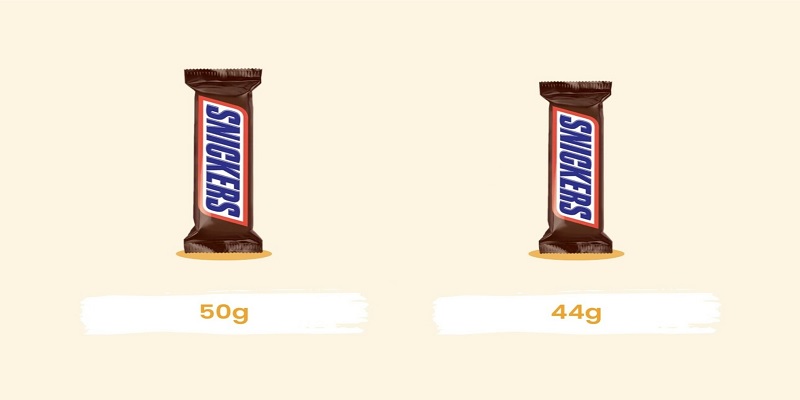
Historically, this method is not new. Some of the earliest documented cases date back to the 1970s in the USA during the period of stagflation. However, in recent decades, especially after financial crises, shrinkflation has become a global and systemic practice. It affects almost all categories of daily consumer goods—from food and beverages to household chemicals and cosmetics.
Thus, shrinkflation in simple terms is a cunning financial maneuver that hits the consumer’s wallet stealthily. To avoid becoming its victim, it is necessary to develop the habit of comparing not only prices but also the unit price—the price per kilogram, liter, or 100 grams of the product. This is the only reliable way to see the real picture.
Inflation and Shrinkflation: What Are the Key Differences?
Although both concepts are related to the loss of purchasing power of money, their mechanisms of operation and consumer perception differ radically. Inflation and shrinkflation are two sides of the same coin, but one is in plain sight, and the other is hidden in the shadows.
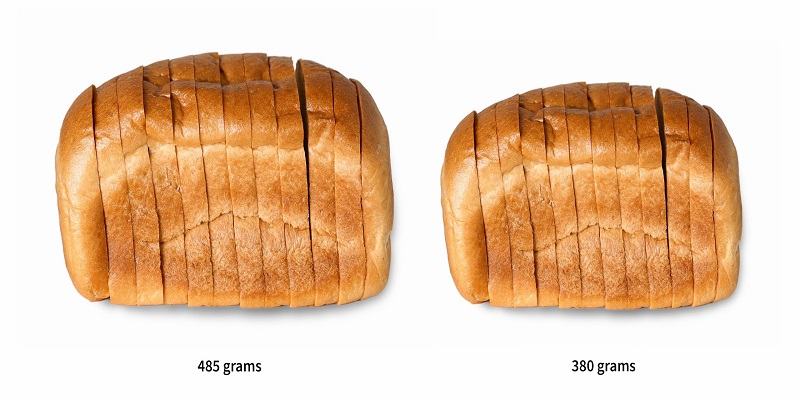
Inflation is an official, macroeconomic indicator. It reflects the overall increase in prices for a basket of goods and services in the economy over a certain period. When the National Bank reports an inflation rate of 7%, it means that the average cost of living has increased by that amount. This process is open, measurable, and is the subject of the state’s monetary policy. The consumer sees inflation directly in the form of new, higher numbers on price tags.
Shrinkflation, on the contrary, is a microeconomic, corporate tactic. It is not directly reflected in official inflation statistics, as the per-unit price of a good may remain the same. The damage is done by reducing the quantity offered. This makes it the “dark matter” of the consumer economy—we know it exists from indirect signs, but it is difficult to accurately measure its contribution to the rising cost of living. A consumer may not notice shrinkflation for years if they do not critically analyze the packaging.
Why Do Companies Choose Hidden Reduction?
The choice in favor of package reduction is due to a combination of marketing and behavioral factors. A direct price increase is psychologically more painful for the buyer. It is perceived as a loss, which may prompt a search for alternatives. Changing the package size, especially if accompanied by rebranding or “formula improvement,” often goes unnoticed.
My personal experience as a consultant shows that during focus groups, consumers can hotly discuss a 10% price increase but almost never recall that six months ago, a pack of coffee weighed 50 grams more.
Moreover, manufacturers often disguise downsizing as care for the consumer. Classic excuses include: “New, more convenient size!“, “Switched to eco-friendly, compact packaging,” or “Concentrated the formula, so you need less product.” These formulations shift the focus from the loss of quantity to an imaginary benefit, which is a brilliant, albeit dishonest, marketing move.

During periods of high volatility in commodity markets, shrinkflation becomes a tool for business to respond quickly. It is technically simpler and faster to change the packaging size on a production line than to reprint all price tags in thousands of stores. This allows companies to promptly pass on rising costs to the consumer while minimizing risks to the brand.
Shrinkflation and Skimpflation: The Nuances of Hidden Price Increases
While shrinkflation remains the most well-known term, it has a more sophisticated “sister“—skimpflation (from the English “skimp” – to be stingy, to economize). If the first steals quantity, the second steals quality. Understanding this difference is critical for protecting your rights as a consumer.
Skimpflation is the practice of deteriorating the quality of a product or service while maintaining the same price. The manufacturer replaces expensive ingredients with cheaper analogs, reduces the meat content in sausages, uses less durable materials in clothing or electronics, reduces staff in a restaurant, leading to poorer service. The result is the same: you pay the same but receive a product with less consumer value.
These two tactics often go hand in hand. A classic example from my consumer experience: a few years ago, a well-known ice cream brand not only reduced the weight of a brick from 100 to 90 grams (shrinkflation) but also started using cheaper vegetable fats instead of dairy fat, which immediately affected the taste and texture (skimpflation). Thus, the company got double savings, and the consumer got a double blow to their wallet and pleasure.
Fighting skimpflation is harder than fighting package reduction. Changes in formulation or materials are not always obvious at first glance and require the consumer to have either deep knowledge or the unfortunate experience of using a low-quality product. The only defense here is carefully studying the composition on the packaging (where the order of ingredients indicates their proportion in descending order) and trust in proven brands, although even they sometimes succumb to temptation.
Real Examples of Shrinkflation from Different Industries
To understand the scale of the phenomenon, it is worth considering specific examples of shrinkflation. This practice is so widespread that by carefully looking at the shelves in a supermarket, you will certainly find several cases on your own.
In the food industry, this is perhaps the most frequent sector for applying this tactic. A pack of butter that used to weigh 200 grams now proudly sits on shelves weighing 180 grams. Yogurts have migrated from 200-gram glass jars to 150-160 gram plastic cups. The amount of cookies in a pack decreases from 500 to 450 grams, and the number of tea bags in a package drops from 50 to 48 or even 40. At the same time, the packaging design often becomes more “premium” or “modern,” distracting attention from the essence.
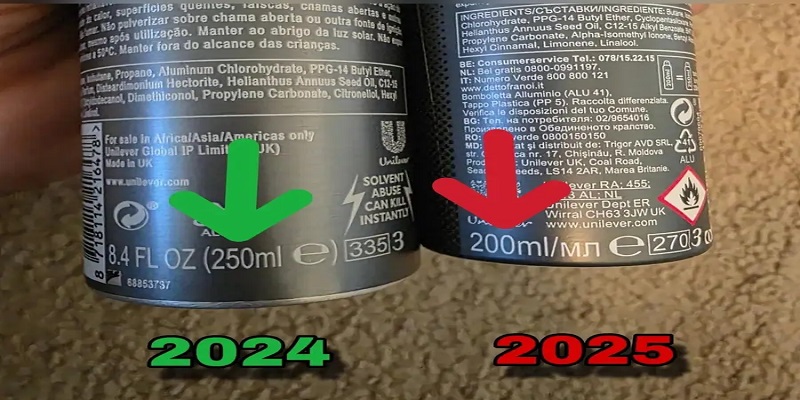
The household chemicals and cosmetics sector is also rich in examples. A bottle of laundry detergent or dishwashing liquid may retain its impressive appearance, but on the back, in small print, a smaller volume will be indicated: not 1000 ml, but 900 ml or even 850 ml. Shampoos and shower gels often switch to “economical” dispensers that release less product per press, which in the long run forces you to buy the product more often. A toothpaste tube may remain the same size, but its walls become thicker, and the bottom becomes concave, hiding the reduction in the actual volume of paste inside.
Even the service market has not been left out. Airlines actively practice “downsizing” space, increasing the number of seat rows and reducing the distance between them (seat pitch) to squeeze more passengers into the cabin. This is a classic example of shrinkflation, where the “product” is comfort, and you get less of it for the same money. Restaurants may discreetly reduce portion sizes or replace ingredients with cheaper ones, keeping the menu price of the dish the same.
What Does Shrinkflation Look Like in Numbers: An Analytical Table
To visually represent the economic effect, let’s consider a conditional shrinkflation table. It demonstrates how a seemingly insignificant weight reduction leads to a significant increase in unit cost.
| Product | Old Weight/Volume | Old Price (rub.) | New Weight/Volume | New Price (rub.) | Unit Cost (rub./kg, l) | Hidden Price Increase |
|---|---|---|---|---|---|---|
| Ground Coffee | 250 g | 500 | 200 g | 500 | 2000 → 2500 | +25% |
| Cheese (pack) | 1 kg | 800 | 900 g | 800 | 800 → 889 | +11% |
| Laundry Detergent | 3 kg | 600 | 2.7 kg | 600 | 200 → 222 | +11% |
| Chocolate | 100 g | 70 | 90 g | 70 | 700 → 778 | +11% |
As can be seen from the table, even if the package price remained unchanged, the real cost of the product for the consumer increased by 11-25%. It is this hidden increase that is the essence of downsizing.
Why Has Downsizing Become a Global Trend?
The spread of shrinkflation and downsizing is not accidental but a natural result of a combination of economic, technological, and psychological factors. It is business adapting to modern realities, unfortunately, at the expense of the end consumer.
The main driver is the global rise in costs. Prices for agricultural raw materials (sugar, cocoa, grain), energy, transport logistics, and packaging materials constantly fluctuate but show an upward trend in the long term. In a highly competitive supermarket shelf environment, openly raising the price is a risky move that could push the buyer towards a competitor who hasn’t raised prices yet. Package reduction seems like a less risky compromise.
The development of packaging technology has also played into the hands of this practice. Modern equipment allows easy reconfiguration of packaging lines to smaller weight or volume. Designers have learned to create packaging that visually appears the same size through optical illusions, non-standard shapes, or more empty space inside (so-called “slap-stick” – concave bottom).
Finally, there is the factor of the legal and regulatory environment. In most countries, legislation requires clear indication of net weight or volume on the packaging but does not prohibit the manufacturer from reducing this weight. The main thing is not to mislead the consumer. Thus, shrinkflation is in a gray legal area: formally, everything is indicated correctly, but the spirit of a fair deal is violated. As economist Paul Krugman noted, such tactics thrive in environments where transparency is low and consumer attention is scattered.
Practical Guide: How to Protect Your Wallet from Hidden Price Increases
Awareness of the problem is already half the solution. The next step is to develop practical habits that will negate the effect of downsizing. These strategies are based on the principle of conscious consumption and simple arithmetic.
The first and most important rule: always calculate and compare the unit price. This is the price per unit of measurement—kilogram, liter, 100 grams, or 100 milliliters. Large retail chains are legally required to display this information on the shelf price tag (the so-called “guide price tag”). Your task is to learn to look at this number first, not at the beautiful packaging or the total price per pack. Often, a product in a large, seemingly advantageous package has a higher unit price than a smaller pack of the same brand.

The second rule: become a “packaging detective.” Pay attention not only to weight but also to:
- The actual size of the product. This is especially true for goods sold individually (cookies, candies, soap). They may become thinner or smaller in diameter.
- Changes in formulation. Study the composition. If a different component than before is suddenly in first place on the ingredient list, or new, unfamiliar names appear (often substitutes), this is a sure sign of skimpflation.
- Design tricks. A new “ergonomic” bottle shape often serves merely as a cover for reducing volume. A concave bottom (slap-stick) in jars and tubes is a classic technique for creating an illusion of fullness.
The third strategy is to review your loyalties. Do not be blindly attached to one brand. Regularly compare offers from different manufacturers, including store brands. They often offer the best price-quality ratio, as they do not incur huge costs for national advertising. Furthermore, competitive pressure is the best way to make big brands more honest.
And finally: document changes. If you notice that your favorite product has become lighter in weight, report it to the manufacturer through feedback on their website or on social media. Mass consumer complaints are one of the few levers of influence that companies are forced to consider, as it directly threatens their reputation.
Frequently Asked Questions About Shrinkflation
Is Shrinkflation a Consumer Deception?
From a legal point of view—not always, if the weight or volume is clearly indicated on the packaging. From an ethical and consumer perspective—absolutely, yes. It is a practice designed to mislead the buyer about the actual cost of the goods, exploiting their inattention and habits. It is a form of hidden price increase that undermines trust between the brand and the consumer.
Have Regulatory Authorities Noticed This Problem?
Yes, in a number of countries, supervisory authorities are beginning to sound the alarm. For example, in France, since 2022, manufacturers have been required to inform retailers of any reduction in product weight or volume, and they, in turn, must inform buyers with special stickers on shelves for at least two months. In Russia, Rospotrebnadzor may consider cases of clear deception, but there is no systemic fight against shrinkflation yet. The main responsibility lies with the consumer themselves.
Can Shrinkflation Be Justified?
Manufacturers often justify it by the need to maintain an affordable price for the consumer in conditions of rising costs. In rare cases, when the change is indeed related to an improvement (e.g., switching to a more concentrated detergent formula where a smaller amount is required), it may have rational merit. However, in the vast majority of cases, it is merely a way to protect the company’s profit, shifting the entire burden of inflation onto the buyer without their explicit consent.
Is a Smaller Size Always Shrinkflation?
No. It is important to distinguish malicious reduction from legitimate marketing moves. For example, launching an additional, smaller, and cheaper format for single people or trial versions is normal. Shrinkflation is considered a situation where a standard, consumer-familiar package (e.g., a 200g butter pack, a 250g coffee jar) is subtly reduced in size, and its place on the shelf or in the assortment is not taken by the old, larger option.
The key takeaway for the consumer is this: in a modern market economy, your attentiveness is your main asset. Awareness of practices such as shrinkflation and skimpflation transforms you from a passive victim of marketing strategies into an active and protected buyer, capable of making informed financial decisions.