In the dynamic and often unpredictable world of digital assets, only a few platforms demonstrate rapid growth capable of attracting the attention of millions of users worldwide. One such platform is Bitget, a cryptocurrency exchange that has transformed from a relatively unknown project into a global leader in just a few years, especially in the derivatives niche. This material provides a detailed review of the Bitget cryptocurrency exchange, designed to give a comprehensive understanding of its functionality, advantages, and features. We will thoroughly analyze key aspects, including questions about who owns the Bitget exchange and the principles on which it operates, so that every reader can form an objective opinion about this platform.
Bitget Cryptocurrency Exchange Review
Founded in 2018, the Bitget platform positions itself as a comprehensive solution for trading digital assets, offering a wide range of financial products. Initially, the exchange focused on the derivatives market, particularly perpetual futures, and it is in this area that it has achieved impressive success, entering the top 5 global exchanges by trading volume for this instrument. Over time, the platform’s functionality has been significantly expanded and now includes spot trading, copy trading, staking, and its own non-custodial wallet. Bitget‘s development strategy has always been focused on a global audience beyond its initial market, which has allowed it to build a significant user base in Europe, Southeast Asia, and Latin America.
One of the distinctive features of the exchange is its focus on innovation and security. The platform actively invests in the development of advanced technologies, such as artificial intelligence for market analysis and machine learning to improve the copy trading system. The user interface is meticulously thought out: it is intuitive for beginners but also offers powerful tools for professional traders, including advanced TradingView charts and various order types. This balance between simplicity and functionality is a key factor in Bitget’s appeal to a diverse audience.
An important element of the ecosystem is the bitget wallet, which was separated into a standalone but closely integrated product. This non-custodial wallet gives users full control over their private keys and supports a vast number of blockchains and tokens, acting as a gateway to the world of decentralized finance. The integration between the exchange and the wallet allows for fast transfers of assets, which significantly simplifies the trading and portfolio management process for experienced users.
Beyond technical aspects, Bitget places great emphasis on education and community support. The platform regularly holds trading competitions, webinars with well-known analysts, and publishes educational materials. Such comprehensive support helps newcomers adapt faster to the complex world of cryptocurrencies, and helps experienced traders find new strategies and earning opportunities. Active participation in community building strengthens user loyalty and contributes to the platform’s organic growth.
As part of our review of the Bitget cryptocurrency exchange, it is also worth noting its ambitious listing program. The platform’s team carefully selects promising projects for addition to the platform, providing traders with early access to new tokens with high growth potential. This approach not only attracts the attention of speculators but also strengthens Bitget‘s reputation as an innovative platform that follows trends and contributes to the development of the entire crypto industry.
Who Owns the Bitget Exchange?
The question of ownership and management is one of the most important when choosing a cryptocurrency exchange, as it directly affects the platform’s transparency, security, and long-term strategy. So, who owns the Bitget exchange? The founder and key figure of the company is Sandra Kou, who holds the position of CEO. Under her leadership, Bitget has grown from a startup to an international corporation with a multi-million user base. Sandra Kou is the public face of the company, frequently speaking at major industry conferences and giving comments to the media, which indicates a high degree of transparency in management.
In addition to the founder, strategic investors have played a significant role in the exchange’s development. Among them are such well-known venture capital funds as Dragonfly Capital and Sequoia Capital China. The participation of such authoritative investors not only provided the platform with the necessary financial resources for scaling but also served as a kind of quality mark, confirming the viability and prospects of Bitget‘s business model. These funds conduct thorough due diligence on projects before investing, and their decision to invest in Bitget speaks to the high trust in the team and its vision.
The ownership structure is built to encourage long-term development rather than short-term profit. A significant portion of revenue is reinvested in improving security, developing new products, and expanding global presence. The company’s policy regarding the management of user assets and profit distribution is clearly defined and available for review, which is an important aspect for building trust. Understanding who is at the helm of the company allows users to be confident in the platform’s stability and reliability in the long term.
The publicity of the leadership and the fame of the investors make it easy to track key personnel and strategic changes within the company. Unlike many anonymous or semi-anonymous exchanges, Bitget demonstrates openness, which, in the context of growing regulation of the crypto market, becomes a critically important competitive advantage. Users can be sure that the platform has a real team and jurisdiction, which significantly reduces operational risks.
We believe the future of finance lies in decentralization, and our mission is to make cryptocurrencies accessible and understandable to everyone. Openness and transparency are not just words for us, but fundamental principles on which our users’ trust is built.
Where is the Bitget Exchange Registered?
Legal transparency is a cornerstone for any financial platform, and Bitget understands its importance. Many users wonder: where is the Bitget exchange registered? On which official website does it operate?
The company is registered in the Republic of Seychelles, which is a common practice for international cryptocurrency exchanges working with a global audience. However, it is important to note that Bitget is not limited to one jurisdiction and is purposefully expanding its presence by obtaining licenses and registering subsidiaries in different countries around the world.
Such a decentralized legal structure allows the platform to flexibly adapt to constantly changing regulatory requirements in various regions. For example, to operate in European markets, the exchange strives to comply with MiCA standards, while in Asia it obtains relevant permits from local financial authorities. This approach demonstrates the seriousness of Bitget‘s intentions to operate legally worldwide and build long-term relationships with regulators, which favorably distinguishes it from platforms that prefer to remain in a gray area.
Information about registration and licenses is typically located in the “About Us” or “Legal Information” section on the official website https://bitget.com. Users can verify this data themselves, which is a good practice before starting active work with any financial platform. Having a clear legal structure not only protects the exchange itself but also provides users with certain guarantees and mechanisms for resolving disputes, which is especially important for large investments.
From a practical standpoint, knowing the jurisdiction helps users understand which legal norms govern their relationship with the platform. This can affect the verification procedure, taxation, and even the available financial instruments. Bitget, aware of this responsibility, strives to communicate information about its legal status as clearly as possible and promptly notify users of any changes in regulatory policy affecting their interests.
How to Use Bitget?
For many beginners, the initial acquaintance with a trading platform can seem complicated, but Bitget’s developers have tried to make the process as intuitive as possible. So, let’s consider how to use the bitget platform effectively and safely. The first step, naturally, is to register an account, which requires providing an email address or phone number and creating a strong password. After that, it is highly recommended to immediately set up two-factor authentication to protect your account from unauthorized access.
The next key step is identity verification. This process is known as KYC and is mandatory for removing withdrawal limits and gaining access to all platform features. The user will need to upload a photo of their identity document and undergo a facial recognition procedure. This usually takes from a few minutes to a few hours. After successful verification, the full functionality of the exchange opens up to the user, and they can proceed to depositing funds and trading.
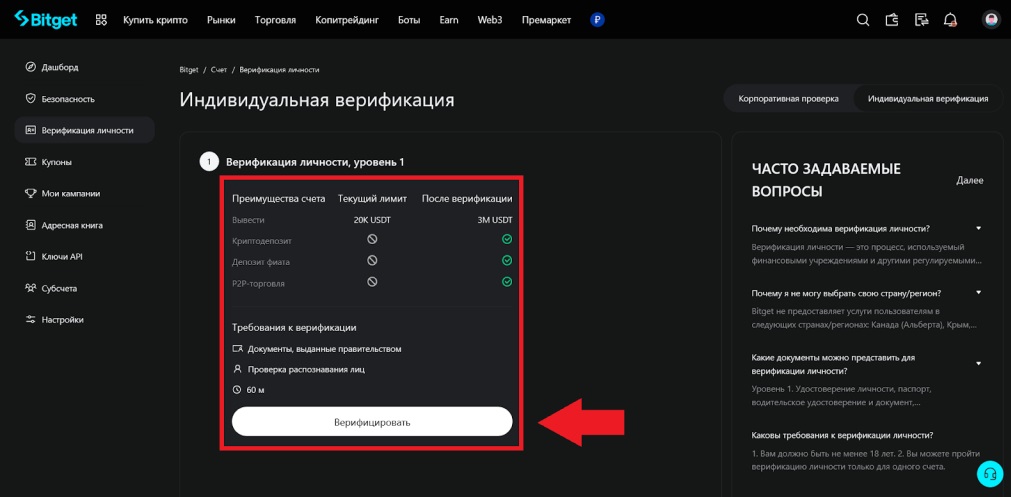
The platform interface is logically divided into several main modules:
- Trading Panel: This contains charts, the order book, trade history, and forms for placing orders.
- Wallet: In this section, you can track balances for all assets, deposit and withdrawal history.
- Copy Trading: A special section where you can select successful traders and automatically copy their trades.
- Futures: A separate interface for trading derivatives with the ability to choose leverage.
For those just starting their journey, the “Arena” section will be extremely useful, where educational materials, guides, and analytics are located. Studying these resources allows you to quickly master the basic principles of trading and understand the logic of the platform’s operation without risking real funds. Bitget also offers a demo account where you can hone your skills in conditions that simulate a real market, but with virtual money.
The author’s experience of this article shows that the platform is indeed convenient for users with different levels of preparation. Personally, as someone who has tried working on several exchanges, I found the Bitget interface to be one of the most balanced. Everything you need is at hand, yet there is no feeling of overload that often arises on platforms aimed exclusively at professionals. Switching between the spot market, futures, and copy trading is done in a couple of clicks, which saves time and allows you to quickly react to changes in market conditions.
How to Top Up Your Bitget Balance?
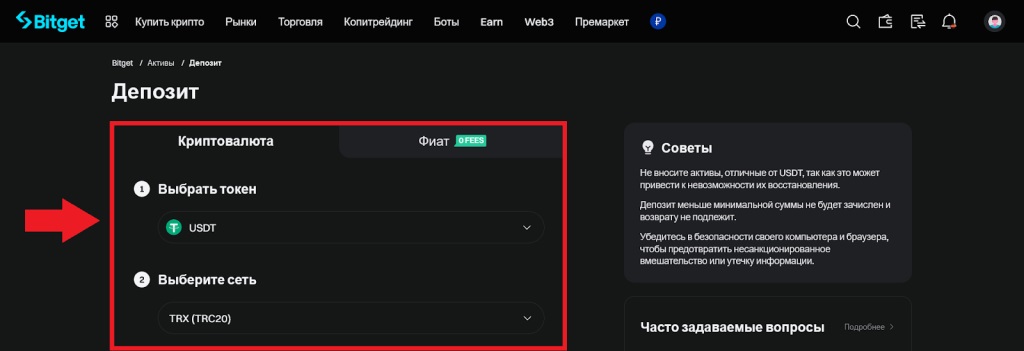
One of the first practical actions for any user is depositing funds into their trading account. The question of how to top up your bitget balance has several solutions, making the platform accessible to users from different countries. The most common and fastest method is depositing cryptocurrency. To do this, you need to go to the “Assets” section, select “Deposit“, specify the desired coin, and copy the provided wallet address. It is to this address that you need to send funds from an external wallet or another exchange.
In addition to cryptocurrency, Bitget is actively developing fiat deposit channels. Users can top up their account using bank cards; both Visa and Mastercard are supported. Various electronic payment systems such as Advcash are also available, as well as the possibility of making transfers through local banks within the framework of partnership programs. It is worth noting that the list of available fiat methods may vary depending on the user’s region, which is related to local regulatory requirements.
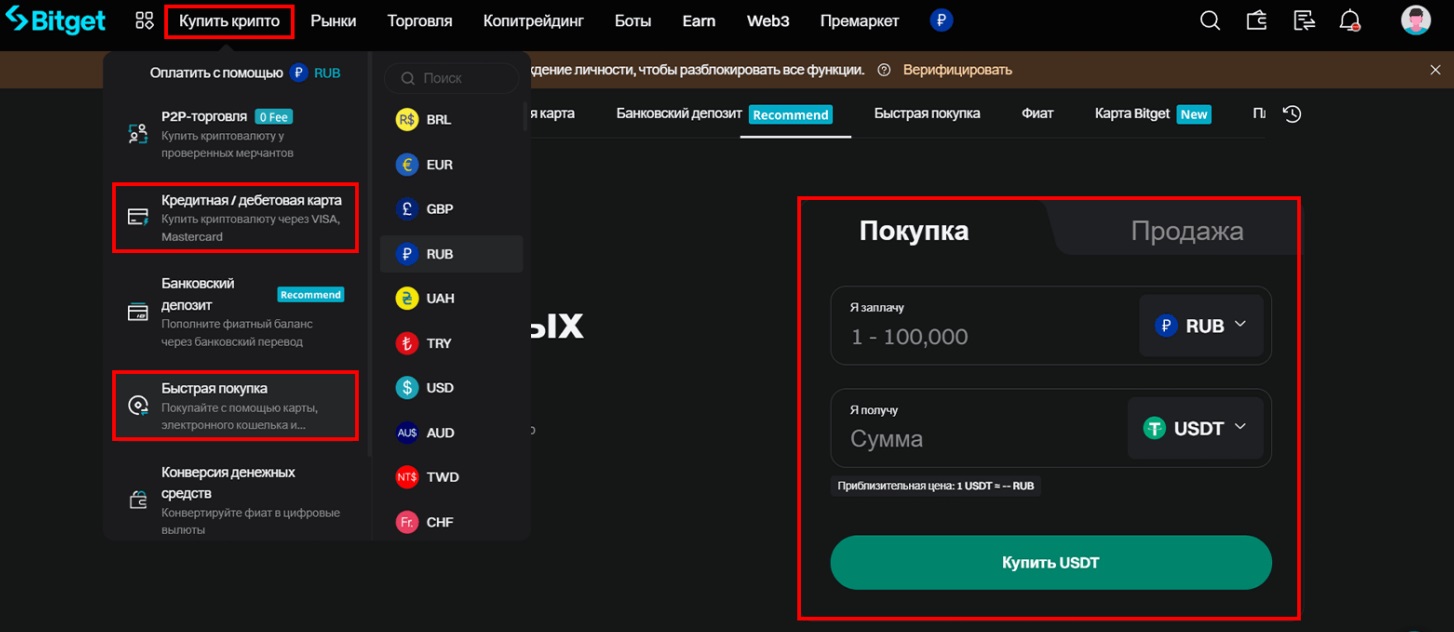
For those who prefer to work with national currency without directly using cards, an excellent solution can be an otc account on bitget. OTC 1Over-the-Counter Trading: This is the process of trading financial instruments (stocks, bonds, cryptocurrency, etc.) directly between two parties (e.g., a buyer and a seller) without the involvement of a formal exchange. stands for Over-The-Counter, meaning off-exchange trading. This mechanism allows for direct buy/sell transactions of cryptocurrency between users at a fixed rate without participation in the public order book. This method is ideal for large amounts, as it avoids price slippage, and for beginners who find it easier to buy cryptocurrency directly for fiat.
The process of topping up via the OTC platform is intuitive: the user selects a seller with a suitable rate and positive reputation, specifies the amount, and follows the system’s instructions. The buyer’s funds are placed in escrow and released to the seller only after the buyer confirms receipt of the cryptocurrency in their balance. This system ensures security for both parties to the transaction. Depositing funds, regardless of the chosen method, in most cases happens quickly enough, allowing users to react promptly to market opportunities.
How to Buy Cryptocurrency on Bitget?
After successfully topping up the account, the next logical step is to acquire digital assets. So, let’s look at how to buy cryptocurrency on bitget in the most effective ways. The simplest and most direct method is using the spot market. In the “Trade” section, you need to select a trading pair, for example, BTC/USDT if you want to buy Bitcoin for Tether. Next, in the order form, you need to specify the amount of BTC you want to buy and the price at which you are willing to do so, or simply click “Buy at market” for the transaction to execute at the best available price at that moment.
An alternative and very popular method, especially among beginners, is using the aforementioned OTC platform. This method essentially answers the question how to buy cryptocurrency on bitget without the need to understand the intricacies of the order book and order types. The user simply selects which currency they want to buy, for which fiat, and in what volume, and the system finds a counterparty for them. It is fast, safe, and straightforward, although the rate may be slightly less favorable than on the spot market in conditions of high spread.
For more experienced users who want not just to buy an asset but also to earn on its fluctuations using borrowed funds, access to margin and futures trading is available. These sections require separate study and an understanding of the high risks associated with leverage. However, they provide powerful tools for generating profit in both rising and falling markets. Bitget provides detailed guides on working with these complex instruments, which helps users make informed decisions.
From personal experience, I would recommend that beginners start with the spot market and limit orders. A limit order allows you to set a specific purchase price, which helps avoid overpaying during periods of high volatility. For example, instead of buying Bitcoin at the current market price of $60,000, you can set an order to buy at $59,500 and wait for the price to reach that level during a brief dip. This tactic requires a bit more patience but allows you to optimize the costs of building a portfolio.
Can Bitget Be Trusted?
The security issue is paramount in the world of digital assets, where the risks of hacks and fraud are, unfortunately, still high. Therefore, it is reasonable to ask: can you trust bitget with your funds? The answer to this question requires a comprehensive analysis. Firstly, Bitget uses a multi-level protection system that includes cold storage for the vast majority of user assets. This means that funds are held in offline wallets, inaccessible to hacker attacks over the internet, which is an industry security standard.
Secondly, the platform has implemented a Protection Fund, which is formed from the exchange’s own funds. This fund is intended to cover potential user losses in exceptional cases, for example, during unforeseen security incidents. The existence of such a fund demonstrates the company’s responsibility towards its clients and its readiness to financially guarantee the safety of funds. Furthermore, Bitget regularly undergoes independent audits of its reserves, publishing so-called Proof of Reserves, which confirms its solvency and the presence of all assets that are listed on user accounts.
An important aspect of trust is regulatory compliance. As mentioned earlier, the exchange strives to obtain licenses in various jurisdictions, which implies adherence to strict standards for combating money laundering and terrorist financing. These measures not only protect the platform itself but also its users, creating a safer and more regulated trading environment. The transparency of the company in matters of ownership and management also adds points to the trust score.
Historically, Bitget has not been involved in major scandals related to the loss of user funds, which certainly speaks in its favor. However, it is important to understand that absolutely secure platforms do not exist, and responsibility lies not only with the exchange but also with the user themselves. Using all available security tools, such as 2FA, an anti-phishing code, and whitelists for withdrawal addresses, significantly reduces personal risks. Thus, the question can you trust bitget can be answered with a cautious yes, supported by specific security measures and the company’s transparent activities.
Bitget Spot Trading Fees
The amount of fees directly affects the profitability of trading, especially for active traders and arbitrageurs. Therefore, analyzing what spot trading fees bitget charges is an important part of choosing a platform. The standard commission for executing trades on the spot market for “takers” is 0.1%. The commission for “makers“, i.e., users who place an order in the order book and thereby add liquidity, is slightly lower — 0.08%. This is a classic model used on many exchanges to encourage liquidity provision.
However, one of the key advantages of Bitget is the system of discounts for using the platform’s native token — BGB. Users who hold a certain amount of BGB in their balance can receive a significant reduction in trading fees. The discount level depends on the volume of BGB held and the user’s 30-day trading volume. For example, under certain conditions, the maker fee can be reduced to 0%, and the taker fee to 0.02%, which is one of the most favorable offers on the market.
For clarity, let’s look at a fee comparison in the table:
| User Level | Taker Fee | Maker Fee |
|---|---|---|
| Level 0 | 0.10% | 0.08% |
| Level 1 (with BGB holding) | 0.06% | 0.02% |
| Level 5 (Maximum) | 0.02% | 0.00% |
In addition to trading fees, users should also consider withdrawal fees. These are not fixed and depend on the specific cryptocurrency, as they are determined by the network load of the corresponding blockchain. Bitget regularly reviews the size of these fees to keep them competitive. Overall, the fee policy on the platform is flexible and transparent, allowing traders to accurately calculate their costs and choose the optimal trading strategy to maximize profits.
What is an OTC Account on Bitget?
For a deep understanding of the platform’s capabilities, it is necessary to analyze in detail what an otc account on bitget is and what practical benefits it can bring. An OTC account is essentially a dedicated section of the platform designed for conducting over-the-counter transactions. Unlike classic exchange trading, where user orders are matched in a common order book, OTC transactions occur directly between two counterparties at a pre-agreed price. This resembles the work of an exchange office, but with a system of guarantees and participant reputation.
The main advantage of the OTC platform is the ability to buy or sell a large volume of cryptocurrency without significantly affecting the market price. On the spot market, a large order can “eat” all the available volume in the order book and significantly move the price, leading to large losses for the trader. OTC trading is free from this drawback, as the price is fixed at the moment of the deal. This tool is especially in demand by institutional investors and large private traders operating with amounts of hundreds of thousands and millions of dollars.
The process of working on the Bitget OTC platform is simple and secure. The user selects a counterparty, focusing on their reputation, volume of completed deals, and reviews. After creating an application and its confirmation by the second party, the buyer’s funds are blocked in an escrow account. As soon as the seller transfers the cryptocurrency to the buyer’s account and the buyer confirms its receipt, the fiat funds are unlocked and transferred to the seller. All communication and the transaction process take place within the platform under its control, which minimizes the risk of fraud.
Thus, the OTC account is an integral part of the Bitget ecosystem, providing a professional solution for large players and a convenient tool for simple cryptocurrency purchases for fiat for beginners. The presence of such a platform significantly expands the exchange’s target audience and makes it competitive not only in the retail but also in the institutional market.
Over-the-counter trading is a bridge between traditional finance and the world of digital assets. We created our OTC platform to give large investors the opportunity to comfortably and safely enter the crypto market, without fear of the negative impact of their own trades on the price.
Bitget Wallet
A separate but critically important element of the ecosystem is the bitget wallet. Originally known as BitKeep, this product was acquired and renamed by Bitget, becoming the official non-custodial wallet of the platform. Its key feature is that users themselves store their private keys and seed phrases, meaning they have full and exclusive control over their assets. This is a classic example of a decentralized wallet that interacts with blockchains directly, without intermediaries.
The wallet’s functionality goes far beyond simple storage. It supports over 90 major blockchains and hundreds of thousands of tokens, making it a universal tool for interacting with the Web3 world. Users can:
- Participate in decentralized finance by providing liquidity and engaging in farming.
- Interact with thousands of dApps 2DApps (decentralized applications) — These are applications that run on a decentralized network, such as a blockchain, instead of a single central server. They differ from traditional applications in that they are not controlled by a single authority, but instead use smart contracts to automatically execute rules and provide greater transparency, security, and data control for users. through the built-in browser.
- Buy cryptocurrency for fiat using cards and other payment methods.
- Exchange tokens directly within the wallet using the DEX aggregator.
Integration with the Bitget exchange is implemented at a high level. Users can quickly transfer assets between the wallet and the trading account on the exchange, which is especially convenient for arbitrage or for using funds stored in the wallet for trading. At the same time, security remains a priority: each transaction requires authorization from the user, and the seed phrase never leaves the device and is not synchronized with the exchange’s servers.
Personally, I use Bitget Wallet for working with decentralized applications on Ethereum and Solana. The convenience lies in the fact that you don’t need to enter the seed phrase every time to connect to a new dApp — it’s enough to confirm the connection in the wallet application itself. Furthermore, the exchange aggregator saves time and money by finding the best rate among all available decentralized exchanges. For anyone seriously interested in cryptocurrency, having a reliable non-custodial wallet is a necessity, and Bitget Wallet is one of the strongest contenders for this role.
How to Earn on the Bitget Wallet Cryptocurrency Exchange?
A wallet is not only a storage tool but also a platform for passive and active earnings. Let’s look at how to earn on the bitget wallet cryptocurrency exchange using its built-in functions. One of the most accessible opportunities is staking. Users can lock certain coins that support the Proof-of-Stake algorithm and receive rewards for it. Interest rates vary depending on the coin and current network conditions, but this is an excellent way to receive passive income without active trading operations.
Another popular method is providing liquidity on decentralized exchanges. A user can contribute a pair of tokens to a liquidity pool and receive a fee from every trade made in that pool. Bitget Wallet significantly simplifies this process by offering a convenient interface for selecting pools and managing liquidity. However, this method is associated with the risk of impermanent loss, so it requires preliminary study.
The decentralized exchange aggregator built into the wallet is itself a tool for earning. It allows you to find the most favorable exchange rates and execute arbitrage trades between different DEXs. Experienced users can track the price difference for the same token on different platforms and profit from it. The wallet also often offers participation in initial offerings of new projects and airdrop programs, which can bring significant income in the long term.
It is important to approach the issue of earning wisely and with an understanding of the risks. Before investing significant amounts in staking or liquidity pools, it is worth starting with small amounts and thoroughly studying the mechanics of the process. Bitget Wallet provides all the necessary tools for analysis and management, but the final decision and responsibility always lie with the user themselves. Diversification of strategies is the key to sustainable earnings in the long term.
Bitget Wallet: How to Withdraw Money to a Card?
Sooner or later, every user faces the task of cashing out earned funds. The question of how to withdraw money from bitget wallet to a card has several solutions, although it should be noted right away that direct fiat withdrawal from a non-custodial wallet is usually not implemented. Since Bitget Wallet is a decentralized product, it works directly with blockchains, not with banking systems. Therefore, the standard path for withdrawal to a card involves using the exchange as an intermediary.
The most common algorithm is as follows. First, the user transfers cryptocurrency from their Bitget Wallet to their spot account on the Bitget exchange. After the transfer is confirmed on the network, the user goes to the exchange itself and uses one of the available fiat gateways. This could be a P2P platform, where you can sell cryptocurrency to another user for national currency with subsequent withdrawal to a linked bank card or account. Alternatively, if the exchange supports direct withdrawal to a card in your region, you can use that function.
Another option is using third-party exchange services or cryptocurrency cards. Some services allow you to top up your balance with cryptocurrency, convert it to fiat, and withdraw it to a card. Cryptocurrency debit cards, in turn, allow you to spend cryptocurrency directly through terminals, automatically converting it to fiat at the moment of payment. Bitget Wallet can be used to top up the accounts of such services.
The withdrawal process is always associated with fees: a network fee for transferring from the wallet to the exchange, a trading fee when selling, and a fee for the fiat withdrawal. Therefore, for small amounts, this path may not be the most profitable. When planning a withdrawal, it is worth calculating the final amount taking into account all costs and choosing the most optimal method based on the volume of funds, region of residence, and available methods. Bitget strives to simplify and reduce the cost of this process as much as possible, constantly adding new fiat channels.
Bitget Sign-Up Bonus
New user incentive programs are a standard marketing tool in the industry, and Bitget is no exception. The offered bitget sign-up bonus serves several purposes: it allows beginners to start trading with minimal risks, introduces them to the platform’s functionality, and motivates them to complete all verification stages. The exact terms of the bonus program may change, so you should always check the current information on the official website, but it usually includes several components.
Most often, a new user receives a small bonus to their account immediately after completing registration and verification. This could be a fixed amount in US dollar equivalent or a certain amount of the native BGB tokens. Further, the exchange may offer a bonus for the first deposit, where the platform credits a certain percentage of the deposited amount. There are also referral programs, where the user receives a reward for each invited friend who has registered and started active trading.
In addition to direct bonuses, new users often receive temporary benefits, such as reduced trading commissions for the first month or free access to premium features, for example, advanced analytics. These measures help to smoothly integrate the user into the ecosystem and demonstrate all the advantages of the platform to them. It is important to read the terms of use of the bonuses carefully, as they may be associated with an obligation to trade a certain volume or maintain a certain period before withdrawing funds.
From the user’s point of view, bonuses are a nice addition, but should not be the main criterion for choosing an exchange. Reliability, security, low fees, and quality functionality are much more important factors in the long run. Nevertheless, by skillfully using the starting advantages, you can slightly increase your initial deposit and gain valuable trading experience with less risk to your own funds.
Bitget Exchange Reviews?
To get a complete picture of any platform, it is necessary to study the opinions of its users. Reviews of the Bitget exchange, collected from various open sources, generally paint a positive image of the platform. Many users highly appreciate the convenience and responsiveness of the user interface, both in the web version and in the mobile application. The copy trading system, which has helped many novice traders take their first steps and make a profit without deep knowledge of technical analysis, receives particularly frequent positive feedback.
Professional traders in their reviews note the high speed of order execution and the stability of the platform even during periods of extreme market volatility, when other exchanges experience overloads. The depth of liquidity for the main trading pairs is also praised, allowing work with large volumes without significant slippage. The frequent and interesting trading competitions with valuable prizes, which add excitement and provide an opportunity to compete with other traders, are separately highlighted.
Critical reviews, as a rule, concern not the platform itself, but rather problems common to the industry. Some users from certain regions complain about a limited number of fiat channels for deposits or difficulties with verification. Sometimes there are complaints about the work of the support service during peak hours. However, it is important to note that the Bitget team often actively responds to such reviews on social networks and thematic forums, trying to promptly resolve users’ problems.
Analyzing reviews of the bitget exchange, we can conclude that the platform enjoys well-deserved respect in the community. Its strengths are considered to be innovative products like copy trading, reliability, and active work with the community. Like any large platform, there are individual rough edges, but the overall trend of reviews indicates constant improvement of the service and attentive attitude to user feedback.
No platform is perfect, but Bitget’s strength is that we learn from mistakes and listen to our users. Every review, both positive and negative, is an opportunity to become better.
Bitget App: Reviews
In the modern world, mobility is a key factor, and Bitget offers a fully functional application for iOS and Android. The bitget app collects reviews that are mostly positive, confirming its quality and convenience. Users note that the developers have managed to transfer all the main functionality of the web platform to mobile devices without loss of performance. The interface is optimized for touch input, all important elements are at hand, and navigation is intuitive.
A key advantage of the mobile application is the ability to react promptly to market changes. Receiving push notifications about price reaching certain levels, quickly placing orders, and the ability to manage copy trading from anywhere are all highly valued by active traders. Stability is also at a high level: the application rarely freezes or crashes, which is critically important at times of making trading decisions.
Some users in reviews express wishes for further improvement, for example, adding more complex tools for technical analysis directly in the application or implementing widgets for the home screen. However, even considering these wishes, the overall rating of the application in official stores remains high. For many traders, the Bitget mobile application has become the main tool for monitoring the market and making trades, which in the conditions of a dynamic life is a significant advantage.
From the standpoint of mobile application security, the same standards are used as in the web version. Access to the account is protected by a password, PIN code, and biometrics, which provides reliable protection in case of device loss or theft. It is recommended to always download the application only from official sources — the App Store or Google Play — to avoid the risk of installing fraudulent copies.
Real Bitget Reviews
In search of objective information, many users strive to find precisely real reviews about bitget, that is, written by real people, not being part of a marketing campaign. Such reviews can be found on independent forums dedicated to cryptocurrencies, in thematic communities on social networks, and on aggregator sites. Analysis of these opinions allows us to identify several recurring themes from different users.
Many real users confirm that the exchange is indeed well-suited for beginners due to the low entry barrier, understandable interface, and copy trading system. Success stories are often related to the fact that people with no prior trading experience were able to make their first profit by following experienced traders. Comments about the timeliness and usefulness of the educational materials and webinars conducted by the platform are also common.
On the other hand, real reviews can also contain constructive criticism. For example, some users note that to access the lowest fees, it is necessary to hold a fairly large amount of BGB tokens, which is not always convenient for small traders. Others point out that the range of coins available for staking could be wider. Such remarks are useful both for the exchange itself in the process of improving the service and for potential users who can assess in advance whether such conditions suit them.
Overall, the picture emerging from real reviews is balanced. The platform has clear strengths that are valued by its users, and some areas for growth that the team, judging by everything, is working on. The absence of major scandals and the positive dynamics of user base growth indirectly confirm that the majority of real reviews reflect the actual state of affairs, and the bitget platform deserves attention from both beginners and experienced traders.
Bitget Wallet Reviews
As for the decentralized component of the ecosystem, reviews of the bitget wallet are also mostly positive. Users actively working with DeFi praise the wallet for its versatility and support for a huge number of networks. The ability to store all assets in one place, without registering on many different exchanges, significantly simplifies portfolio management. The convenience of the built-in exchanger, which saves time searching for the best rate across different DEXs, is especially noted.
The experience of interacting with NFT collections also receives high marks. The wallet allows you not only to store NFTs but also to easily buy, sell, and exchange them directly from the application. Integration with major marketplaces makes the process simple and secure. For users immersed in the Web3 world, Bitget Wallet becomes a real hub that unites all their activities in one interface.
Critical remarks are usually related to complexity for absolute beginners. Decentralized wallets require more responsibility and understanding of blockchain basics than centralized exchanges. Some users, accustomed to the fact that an exchange can restore access to an account, have difficulties with independently managing the seed phrase and private keys. However, this is not a drawback of the wallet itself, but rather a feature of the entire paradigm of non-custodial solutions.
In conclusion, we can say that Bitget Wallet is a powerful and modern tool that perfectly complements the main exchange. It provides access to the full spectrum of possibilities of the decentralized internet and finance. For users who want not just to trade but to be full participants in the Web3 ecosystem, this wallet becomes a reliable and functional companion, as evidenced by the overwhelming majority of user ratings.

📝
- 1Over-the-Counter Trading: This is the process of trading financial instruments (stocks, bonds, cryptocurrency, etc.) directly between two parties (e.g., a buyer and a seller) without the involvement of a formal exchange. ↩︎
- 2DApps (decentralized applications) — These are applications that run on a decentralized network, such as a blockchain, instead of a single central server. They differ from traditional applications in that they are not controlled by a single authority, but instead use smart contracts to automatically execute rules and provide greater transparency, security, and data control for users. ↩︎