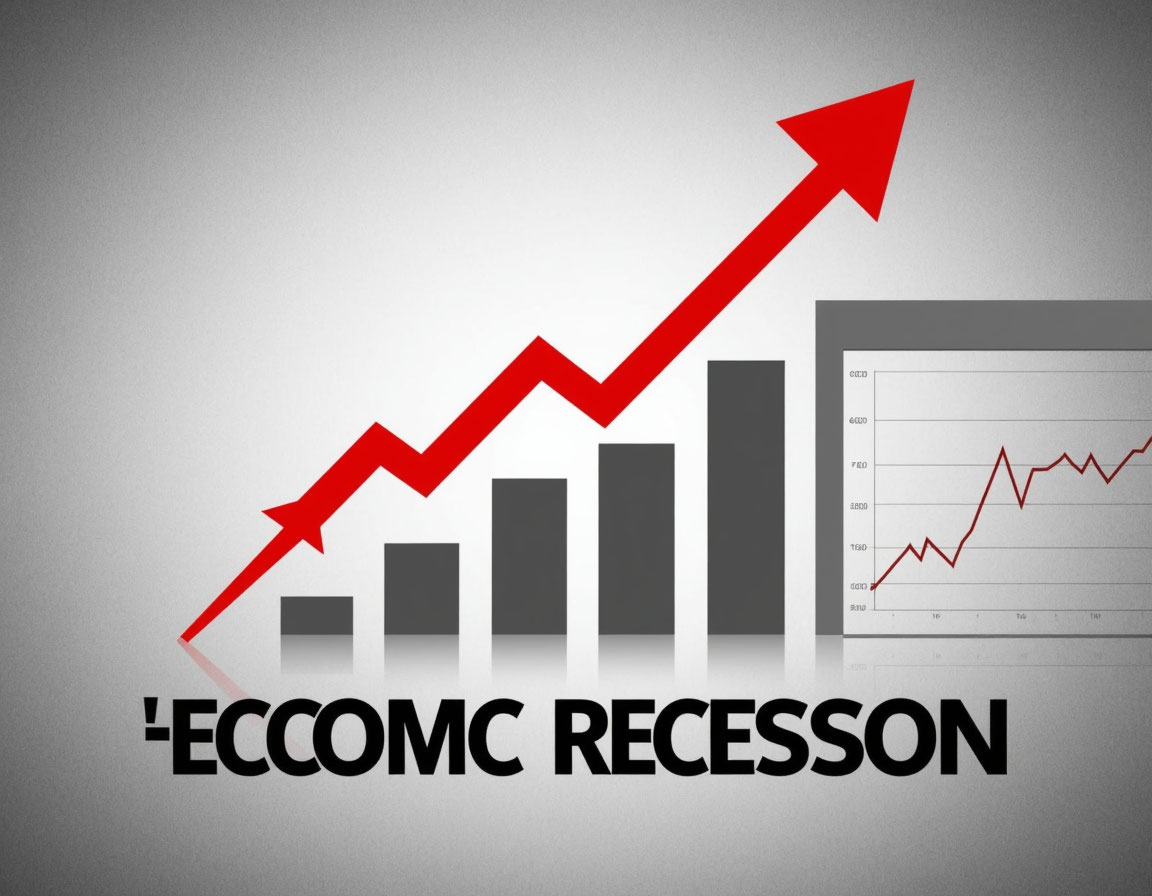
A recession is an economic downturn characterized by a sustained decline in business activity for at least two consecutive quarters. During this period, there is a decrease in gross domestic product (GDP), a drop in production and consumption, a rise in unemployment, and a reduction in the population’s real income. Recessions are a cyclical phenomenon in the economy and can last from several months to several years.
Economic Downturn: The Invisible Force That Changes the World
The economy, like a living organism, is subject to cycles of booms and busts, periods of prosperity and temporary calm. Among these phases, one causes the greatest concern for governments, businesses, and ordinary citizens, becoming a central topic in news headlines and a subject of heated debate. This phenomenon is Recession 1A macroeconomic term denoting a significant decline in economic activity. The main indicator of a recession is a decline in GDP for two consecutive quarters., technically defined as a significant decline in economic activity, capable of upending the lives of millions, rewriting political maps, and testing the resilience of financial systems worldwide. Understanding its nature, causes, and consequences is not just an academic exercise but a necessary condition for navigating the turbulent waters of the modern world. This material offers a deep dive into the essence of this complex phenomenon, exploring its mechanisms, historical examples, and survival strategies, proving that knowledge is the first and most powerful tool against uncertainty.
What is a Recession? Understanding the Basics
What is a recession — many ask themselves this question when they hear alarming forecasts from analysts. Formally speaking, this term usually refers to a significant decline in economic activity lasting more than a few months. It is reflected in key macroeconomic indicators such as gross domestic product, employment levels, retail sales, and industrial production. The classic rule for identifying this condition is the rule of two consecutive quarters of falling GDP, although economists consider a broader set of data. It is a phase of the business cycle that follows a peak and precedes a depression or recovery, depending on the depth and duration of the downturn.
Economic recession in simple terms can be described as a period when a country’s economy is operating at half capacity. Imagine a factory that used to produce a thousand goods a day and now produces only seven hundred. Accordingly, it requires fewer workers, orders for raw materials are reduced, and store sales fall. This domino effect affects everyone: from large corporations to individual families. People start spending money more cautiously, postponing major purchases, companies freeze investments 2Investments represent the placement of capital with the aim of generating profit or protecting it from depreciation. There are two main forms: financial (e.g., purchasing stocks and bonds) and real (investments in production, real estate, and other tangible assets). Furthermore, there is a more detailed classification including private and public, speculative and venture investments, as well as many other varieties. and the hiring of new staff. During such a period, money seems to freeze, its circulation slows down, and the overall wealth of society temporarily stops growing, and often even decreases.
To fully understand the essence, it is useful to understand what the word recession means. The term comes from the Latin word “recessus“, meaning “retreat” or “withdrawal“. This very accurately reflects the nature of the phenomenon — it is a retreat of the economy from a previously achieved level of development. It is not a random failure, but a natural phase of the cycle, a stage of “respite” and redistribution of resources after a period of rapid growth. Understanding this helps to realize that such downturns, however painful they may be, are an integral part of long-term economic development. They wash out inefficient business models and prepare the ground for a new cycle of innovation and growth.
A historical example demonstrating the complexity of this phenomenon is the so-called Roosevelt Recession of 1937-1938. Despite the active measures of the “New Deal” aimed at emerging from the Great Depression, the American economy faced a new sharp downturn. Among the reasons cited are premature fiscal tightening, cuts in government spending, and measures by the Federal Reserve to increase reserve requirements for banks. This episode clearly shows how fragile recovery can be and what the cost of errors in macroeconomic regulation is. It serves as an important lesson about the need for consistent and balanced policies even after the first signs of improvement appear.
Thus, this economic phenomenon is a multifaceted and complex occurrence. It is not just dry statistics, but a profound socio-economic process affecting the welfare, psychology, and future prospects of entire generations. Its study requires consideration of many interrelated factors, from global financial flows to the consumer sentiment of ordinary people.
Why Does a Recession Happen? The Mechanisms of Economic Downturn
Why does a recession happen — this is the central question, the answer to which lies in understanding business cycles. The economy does not move in a straight line; it develops cyclically, going through periods of expansion, peak, contraction, and trough. A downturn is a natural part of this process, often caused by market saturation after a prolonged boom. Investments during a boom can become excessive and inefficient, creating “bubbles” in asset markets, be it real estate, stocks, or commodities. When these bubbles burst, a chain of defaults and loss of confidence triggers a process of general contraction in business activity.
One of the powerful modern triggers can be sanctions as a trigger for recession. In a globalized economy, the imposition of strict trade and financial restrictions against a major economy can send shockwaves throughout the world. Sanctions disrupt established supply chains, block settlements, lead to the isolation of countries from global financial markets and technologies. This forces economies to urgently restructure, which is almost always accompanied by a sharp decline in production, rising inflation, and a fall in real incomes of the population. Such measures, pursuing political goals, often have unintended and large-scale economic consequences for all involved parties.
Very often, a downturn is accompanied by a whole range of interrelated problems, which can be described as inflation, stagnation 3A period of very low or absent growth in the economy. The main sign of stagnation is a slowdown in GDP growth rates within 0-3%., recession and devaluation. Inflation, that is, a sustained increase in the general price level, undermines purchasing power. If it is combined with stagnation — zero or very low economic growth — stagflation occurs, an extremely unpleasant phenomenon for regulators. To combat inflation, central banks are forced to raise interest rates, which makes credit more expensive and suppresses investment activity, pushing the economy towards a downturn. Devaluation, a sharp weakening of the national currency, although it can stimulate exports, simultaneously drives up prices for imported goods, exacerbating inflation and reducing the standard of living. This vicious circle is extremely difficult to break.
Other common causes include a sharp tightening of monetary policy aimed at curbing inflation, as was the case in the early 1980s in the US. Financial crises, like the 2008 crisis, when the collapse of the real estate market and derivative financial instruments led to a chain of bankruptcies and a liquidity crisis. External shocks also play a role, such as the sharp spike in oil prices in 1973, which led to an energy crisis and a prolonged period of stagflation in Western countries. Each historical episode has its unique features, but the basic mechanisms remain similar.
Thus, the causes of an economic downturn are rarely singular. Usually, it is a complex cocktail of internal imbalances, external shocks, and errors in regulatory policy. Understanding these cause-and-effect relationships allows not only to explain past crises but also, with a certain degree of probability, to predict future ones.
Anatomy of a Crisis: What Happens During a Recession?
What happens during a recession — this question is best revealed by observing changes in the behavior of all economic participants. The first and most noticeable symptom is rising unemployment. Companies, faced with a drop in demand for their products and services, are forced to cut costs. The largest expense item is often the payroll, so layoffs, reduced working hours, and hiring freezes begin. The growth of the army of unemployed, in turn, leads to a further decline in consumer spending, closing the vicious circle.
Another key aspect is the fall of the stock market. Investors, expecting a decline in corporate profits, start selling stocks en masse, causing market indices to plummet. The fall in asset value exacerbates companies’ problems, depriving them of the opportunity to raise capital through stock offerings. In parallel, real estate prices usually fall, as potential buyers lose income and confidence in the future, and loans become less accessible. This deals a blow to household wealth and the banking system, for which real estate is a key collateral asset.
From the state’s perspective, how the economy works during a recession can be characterized as a deficit mode. The decline in business activity leads to a reduction in tax revenues to the budget. At the same time, government spending increases due to the need to pay higher unemployment benefits and fund economic support programs. A budget deficit arises or increases, forcing the government to either cut social programs or increase public debt. Central banks in such a situation usually switch to a stimulative policy, lowering interest rates and increasing the money supply to “jump-start” the economy.
Consumer behavior changes drastically. People start postponing major purchases such as cars, appliances, and real estate. Savings “for a rainy day” increase, even if deposit interest rates are low. The structure of consumption changes: demand shifts towards cheaper goods and essentials. Business, in turn, postpones expansion plans, freezes investment projects, and focuses on survival, optimizing its operational processes and cutting any non-essential spending.
As a result, the economy enters a state of a kind of hibernation. Its vital signs — production, consumption, investment — weaken. This process is painful, but it also performs a sanitary function, cleansing the economy of inefficient companies and excess capacity. Understanding the internal mechanics of these processes is the first step towards developing strategies not only for survival but also for benefiting from the situation.
Harbingers of Recession: Reading the Economy’s Signals
Harbingers of recession — these are the indicators that experienced analysts track to predict an approaching storm. One of the most reliable leading indicators is the inverted yield curve of government bonds. Under normal conditions, long-term bonds have higher yields than short-term ones, compensating investors for the longer term. When short-term rates become higher than long-term rates, the curve inverts. This signals that investors expect an economic slowdown and future rate cuts by the central bank. Historically, such inversion has often preceded economic downturns.
Another important signal is a decline in business confidence and consumer sentiment indices. These surveys reflect the expectations of managers and ordinary households regarding the future of the economy. When entrepreneurs become pessimistic about sales and profit prospects, they cut investment plans and inventories. Consumers, expecting a deterioration in their financial situation, start spending less and saving more. Since expectations have the property of a self-fulfilling prophecy, mass pessimism can itself provoke a downturn in business activity.
It is also worth paying attention to the dynamics of leading economic indicators, such as volumes of orders for durable goods, building permits, and industrial production figures. A decline in these indicators points to weakening fundamental demand in the economy. The labor market is particularly indicative: although unemployment is a lagging indicator, a slowdown in the pace of new job creation or an increase in unemployment benefit claims can be early warning signs. A sharp increase in non-performing loans also indicates growing financial stress in the economy.
At the global level, a slowdown in world trade is an alarming signal. Declining shipping volumes, falling commodity prices, and decreasing global supply chain indices indicate weakening global demand. In the modern interconnected economy, a crisis in one major region inevitably affects its trading partners. Thus, monitoring these and other signals allows, if not to prevent a downturn, then at least to prepare for its consequences in advance.
Why is a Recession Dangerous? The Multifaceted Risks of a Downturn
Why a recession is dangerous becomes obvious when analyzing its long-term socio-economic consequences. Beyond the obvious decline in living standards, it inflicts “scars” on the economy that take years to heal. One of the most destructive is “human capital“. Prolonged unemployment leads to deskilling of workers, loss of professional skills and motivation. University graduates entering the labor market during a downturn are often forced to accept low-paid and unrelated work, which negatively affects their career trajectory and future income throughout their lives. This phenomenon is known as the “scarring effect“.
From the state’s perspective, a country’s recession is a serious challenge for the political and financial system. A sharp reduction in tax revenues against the backdrop of rising social spending undermines budget balance. The government is forced to increase public debt, creating risks for future generations and potentially leading to a debt crisis. Social tension rises, the level of poverty and social inequality increases. This can lead to political instability, changes in government, and the rise of populist sentiments, which further complicates the implementation of necessary but unpopular economic reforms.
For business, the main danger is a liquidity crisis and the problem of survival. Even promising and efficient companies can go bankrupt due to a chain of defaults and lack of access to credit. The downturn kills innovative activity, as businesses are forced to fight for current survival, postponing long-term research and investment projects. This undermines the country’s competitive position in world markets in the future. Furthermore, market concentration occurs when larger and financially stable companies absorb weakened competitors, which can reduce competition and in the long run lead to price increases for consumers.
It is especially important to understand what will happen during a recession to the financial system. Banks, faced with an increase in loan defaults and a fall in collateral value, tighten lending conditions. A “credit crunch” occurs, where even reliable borrowers cannot obtain financing. This paralyzes investment and consumption. Panic in financial markets can lead to a collapse of the national currency, triggering capital flight from the country and a sharp increase in inflation. In the most severe cases, a liquidity crisis turns into a solvency crisis of the entire banking system, requiring large-scale and costly state interventions to save it.
What is the Difference Between Recession and Stagnation?
The question often arises: What is the difference between recession and stagnation? Although both conditions indicate problems in the economy, they are fundamentally different in their dynamics. Recession is an active, explicit, and often sharp decline in key economic indicators. It is a phase of the cycle characterized by negative GDP growth rates, a contraction in business activity, and rising unemployment. It is a downward movement, a painful but usually relatively short period of cleansing and adaptation. An economy in a downturn phase is like a car rolling downhill with acceleration.
Stagnation, in contrast, is a state of stagnation. The economy is not falling, but it is not growing either, or is growing at negligible rates that do not allow for an improvement in the standard of living of the population. It is an “economic coma“, a prolonged period of lack of development. A classic example is the Japanese economy after the burst of the asset bubble in the early 1990s, which for decades showed near-zero growth despite ultra-low interest rates and large-scale fiscal stimulus. In this state, structural problems accumulate but are not resolved.
Let’s compare these two conditions in a table:
| Criterion | Recession | Stagnation |
|---|---|---|
| GDP Dynamics | Negative growth | Zero or very low growth |
| Duration | Relatively short (months, years) | Long (years, decades) |
| Unemployment | Rises rapidly | Remains consistently high |
| Investments | Sharply fall | Chronically low |
| Main Challenge | To stop the fall | To start growth |
Thus, if a downturn is an acute illness, then stagnation is a chronic disease. And the answer to the question “What is worse than a recession“, in simple terms, is ambiguous. An acute illness is painful but often hardens the body and leads to recovery. A chronic illness, however, depletes strength and deprives hope for a better future. Many economists consider prolonged stagnation more dangerous, as it undermines the potential for long-term growth and leads to the loss of an entire generation in terms of economic development.
What to Do During a Recession? Strategies for Citizens and Businesses
What to do during a recession — this is a practical question that concerns everyone who wants to preserve their financial well-being. For an ordinary citizen, the first and most important step is to strengthen financial security. It is necessary to create a “safety cushion” of at least 3-6 months of current expenses. This money should be kept in a highly liquid form, for example, in a bank deposit in a reliable bank. One should critically review their budget, cutting non-essential expenses such as entertainment, expensive purchases, and impulse spending. Postponing major purchases, especially those taken on credit, is a wise decision in times of uncertainty.
From a career perspective, the key strategy is to increase one’s own value in the labor market. During a downturn, competition for jobs intensifies. Employees with unique skills, multitasking abilities, and high efficiency are valued. This is the time to invest in one’s own education, obtain additional qualifications, or master an adjacent profession. It is important to show loyalty to the current employer and demonstrate one’s indispensability, but at the same time be prepared to search for new opportunities and respond flexibly to changes in the market.
For business, the strategy of survival and adaptation looks different. The main focus should be on preserving cash flows and optimizing operational expenses. It is necessary to audit all cost items, identify and reduce inefficient spending. It is important to diversify suppliers and the customer base to reduce dependence on a single source of income or raw materials. Businesses should consider entering new, possibly less affected markets or niches. Investment in marketing, paradoxically, often pays off in a crisis, as competition for the attention of the weakened consumer decreases.
How to Make Money During a Recession?
The question of how to make money during a recession? deserves special attention. Although it seems counterintuitive, an economic downturn creates unique opportunities for investment. Prices for assets, be it stocks or real estate, often fall to levels that do not reflect their long-term value. The strategy of “value investing“, i.e., buying undervalued assets and waiting for their recovery, can bring significant profit in the long term. Opportunities also open up in sectors that are less sensitive to the cycle, such as the production of essential goods, repair services, discount retail, and cheap entertainment.
As the famous investor Warren Buffett said: “Be fearful when others are greedy, and greedy when others are fearful“.
Thus, the key to success during economic difficulties is proactivity, discipline, and a willingness to adapt. Instead of succumbing to panic, it is necessary to calmly assess one’s strengths and weaknesses, revise financial plans, and be ready to seize emerging opportunities. History shows that those who remain calm and act thoughtfully not only survive the downturn but often emerge from it stronger.
Ways Out of a Recession: Tools of Economic Policy
Speaking of ways out of a recession, we primarily mean the actions of the state and the central bank. These measures can be divided into two main directions: monetary (money-credit) and fiscal (budgetary-tax). The central bank is usually the first on the battlefield against the crisis. Its main tool is lowering the key interest rate. Cheap credit encourages businesses to borrow for investment and households for consumption. If rate cuts are not enough (the so-called “liquidity trap”), the central bank resorts to unconventional measures, such as quantitative easing — large-scale purchases of government and sometimes corporate bonds to pump money into the economy.
Fiscal policy is in the hands of the government. It involves increasing government spending and/or reducing taxes. The government can launch large-scale infrastructure projects (construction of roads, bridges, ports), which creates jobs and stimulates related industries. Tax cuts, especially for businesses and people with middle incomes, increase their disposable funds, boosting demand. Direct payments to the population, subsidies to businesses in difficult situations — all this is also part of the arsenal of fiscal stimulus. The effect of such measures is usually faster, but they lead to an increase in public debt.
Historically successful examples of combining such measures are Franklin Roosevelt’s policies during the Great Depression (“New Deal“) and the actions of world governments after the 2008 crisis. However, choosing the right balance is an extremely difficult task. Too early or too abrupt a withdrawal of stimulus can plunge the economy into a new wave of downturn, as happened with the Roosevelt Recession of 1937. Too prolonged stimulation is fraught with accelerating inflation and creating new “bubbles” in asset markets. Economists have been debating the effectiveness of various measures for decades, and there is no universal recipe.
Ultimately, exiting an economic downturn is a complex and often painful process requiring coordination between the state, business, and society. Success depends not only on the tools applied but also on trust in policymakers, the flexibility of economic institutions, and society’s ability to consolidate in the face of common problems. Recovery typically begins with a revival in the stock market, then unemployment gradually decreases, and finally, consumer confidence is restored, which marks the return to healthy economic growth.

📝
- 1A macroeconomic term denoting a significant decline in economic activity. The main indicator of a recession is a decline in GDP for two consecutive quarters.
- 2Investments represent the placement of capital with the aim of generating profit or protecting it from depreciation. There are two main forms: financial (e.g., purchasing stocks and bonds) and real (investments in production, real estate, and other tangible assets). Furthermore, there is a more detailed classification including private and public, speculative and venture investments, as well as many other varieties.
- 3A period of very low or absent growth in the economy. The main sign of stagnation is a slowdown in GDP growth rates within 0-3%.