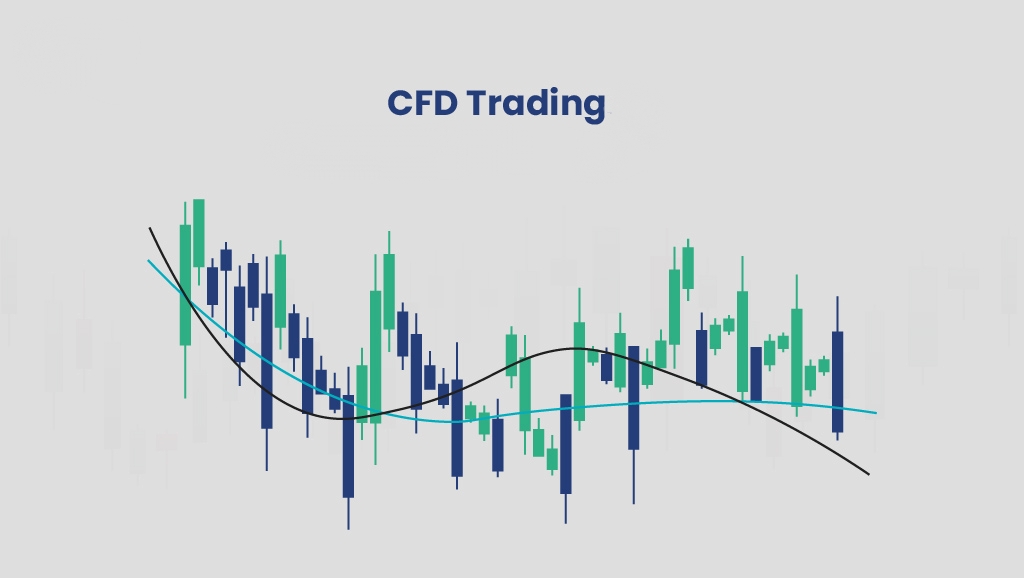
Contract for Difference (CFD) is a financial instrument that allows traders and investors to profit from the price movement of an asset without actually owning the underlying asset. Literally, CFD stands for “Contract for Difference.” It is an agreement between a trader and a broker to exchange the difference in the value of an asset between the time the contract is opened and when it is closed. CFD trading involves the use of leverage, which allows traders to control large positions with a relatively small amount of initial capital.
This instrument has gained popularity due to its accessibility and the wide range of available markets. However, it carries high risks, especially for beginner traders. CFDs are prohibited for retail trading in some countries, including the United States, but remain legal in many other regions, such as the UK and European countries.
What is a Contract for Difference (CFD)?
A CFD is essentially a bet on whether the price of an asset will go up or down. When you buy a CFD on a stock, you do not become the owner of the share and do not receive shareholder rights, such as dividends (although some brokers may compensate for them with a cash equivalent). You enter into a contract with a broker where you agree to receive or pay the difference between the asset’s price at the opening and closing of the trade.
The key feature of CFDs is the use of leverage. Leverage allows you to deposit only a small fraction of the contract’s full value (a deposit known as margin) but receive a profit or loss equivalent to the full value of the trade. For example, with 1:10 leverage, you would need only $1,000 of your own funds to control a $10,000 position. This magnifies both potential profits and potential losses.
CFDs are a type of derivative financial instrument. This means their price is derived from the price of an underlying asset, such as stocks, indices, currencies (Forex), commodities, or cryptocurrencies. Traders use CFDs for speculation on short and medium-term price movements, as well as for hedging risks in their other investments.
CFD in the Stock Market
CFDs are not traded on major stock exchanges like regular stocks. All CFD transactions occur over-the-counter (OTC). This means the contract is made directly between the trader and the brokerage firm. The broker acts as the counterparty to the trade, meaning they are the opposite side for all of their clients’ transactions.
Even though CFDs are an OTC instrument, their price is directly dependent on the quotes of the underlying asset on major world exchanges. For example, a CFD on Apple stock will mirror the price movement of Apple shares on the NASDAQ exchange. This allows traders to effectively speculate on exchange movements without having direct access to the exchange itself.
For the trader, it looks like this: they open a trading terminal provided by their broker and see quotes for thousands of assets. When they execute a trade, they are entering into a contract with that specific broker. The advantage of this approach is the huge selection of markets from a single interface and access to leverage.
How to Trade CFDs?
CFD trading is based on a simple principle: buy (open a long position) if you expect the price to rise, or sell (open a short position) if you expect the price to fall. The ability to profit from a falling market is one of the key advantages of CFDs, which is not easily available in traditional investing without complex procedures.
The trading process begins with analysis. Traders use technical analysis (studying charts and indicators) and fundamental analysis (evaluating economic news and company reports) to forecast price movements. After that, they select an asset, determine the trade size, and place orders.
The most important element of risk management is the stop-loss and take-profit order. A stop-loss is an order to automatically close a position when a certain loss level is reached, preventing further losses beyond a planned amount. A take-profit order, conversely, automatically locks in profits when the price reaches a target level. Without these tools, CFD trading becomes extremely risky.
CFD in America
In the United States, CFD trading is largely prohibited for retail traders. The primary regulators, the Securities and Exchange Commission (SEC) and the Commodity Futures Trading Commission (CFTC), do not allow brokers to offer these instruments to the general public. The main reason is the high level of risk associated with leverage and the OTC nature of these contracts, which regulators believe are not suitable for the average retail investor.
The US financial market offers alternative instruments for speculation, such as options and futures, which are traded on regulated exchanges. For those interested in leveraged forex trading, there is a specific market with its own rules, but it is distinct from the broader CFD market offered elsewhere in the world.
For most retail traders in the US, access to CFDs through regulated domestic brokers is closed. Some international brokers may accept US clients, but this often operates in a regulatory gray area and carries significant risks, including a lack of investor protection under US law. Therefore, US traders typically use other, more regulated derivatives.
Contract for Difference
The name “Contract for Difference” perfectly describes the essence of this instrument. The entire trade boils down to calculating the price difference. Suppose you open a contract to buy a CFD on a stock at $100. After some time, the price rises to $110, and you close the contract.
The calculation is simple: ($110 – $100) × number of shares = your profit. If the price had fallen to $90, you would have incurred a loss of ($90 – $100) × number of shares. This difference, multiplied by the trade volume, is the financial result of the operation. Broker commissions and swap fees (the cost of holding a position overnight) are deducted from this result.
Understanding Contracts for Difference (CFD)
To trade CFDs successfully, it is important to understand several basic concepts. The first is leverage. It multiplies your purchasing power but also multiplies your risks. Incorrect use of leverage is the primary cause of large losses.
The second concept is margin. This is the amount of your own funds you must deposit to open a position. If the market moves against you and your losses approach the margin amount, the broker will issue a margin call (a demand to top up your account) or forcibly close the position (a stop-out) to prevent a negative account balance.
The third important concept is short selling (going short). CFDs make it easy to open short positions, meaning you can sell an asset you don’t own, betting on its price decrease. This creates a two-way market and provides opportunities to profit even in a bearish trend.
Reasons for the Ban on CFD Trading
The main reason for the ban on CFDs in many countries for retail traders is the high level of risk. Due to leverage, an investor can lose their entire deposit very quickly and even end up owing money. Regulators believe that most private investors do not have sufficient knowledge to manage such risks.
Another reason is the conflict of interest. In a model where the broker is the counterparty, its profit may directly depend on client losses. Although reputable brokers operate on an STP/ECN model and route trades to the interbank market, the mere potential for a conflict of interest raises concerns among regulators.
Regulators also point to the complexity of the product. CFDs are a derivative, and their mechanism is not always fully understood by the average investor, who may not be aware of all the consequences of using leverage and the mechanics of margin trading.
Global Markets for CFD Trading
CFDs provide access to a vast number of global markets from a single trading platform. The main ones include:
- Stocks: CFDs on shares of thousands of companies from around the world (US, Europe, Asia).
- Indices: CFDs on stock indices like the S&P 500, NASDAQ 100, FTSE 100, and DAX 40. This allows you to bet on the health of an entire economy or sector.
- Currency Pairs (Forex): Trading CFDs on currency exchange rates, such as EUR/USD or GBP/JPY.
- Commodities: CFDs on oil, gold, silver, copper, and agricultural products.
- Cryptocurrencies: CFDs on Bitcoin, Ethereum, and other popular crypto assets.
Understanding the Costs of CFD Trading
Trading CFDs is not free. Besides the spread (the difference between the buy and sell price), which is the broker’s primary commission, there are other costs.
- Spread: The narrower the spread, the better for the trader, as the price must immediately move beyond the spread after opening the trade to become profitable.
- Overnight Financing Charge (Swap): If you hold a position open for more than one day, a fee may be charged or credited, depending on the interest rate differential between the two currencies or assets.
- Commissions: Some brokers charge a fixed commission for opening and closing positions on certain stocks or indices.
A Step-by-Step Guide to CFD Trading
Trading Plan
- Choosing a Broker: Find a reliable, regulated broker.
- Market Analysis: Use technical and fundamental analysis to find a trading opportunity.
- Trade Planning: Determine your entry point, position size, and stop-loss and take-profit levels.
Opening a Position
- Selecting an Asset: Find the desired asset in the trading terminal.
- Choosing Direction: Click “Buy” (if expecting a rise) or “Sell” (if expecting a fall).
- Setting Volume: Specify the position size (e.g., 0.1 lots).
- Placing Orders: Immediately set stop-loss and take-profit orders.
Holding a Position
After opening a position, you can monitor its status in real-time in your portfolio. Keep an eye on news that could affect your asset’s price. If necessary, you can manually move your stop-loss or take-profit levels.
Closing a Position
The position closes automatically when the price hits the stop-loss or take-profit level. You can also close it manually at any time by clicking the “Close Trade” button next to the open position in your portfolio.
Calculating the Final Result
Formula for a Long Position (Buy): (Closing Price – Opening Price) × Trade Volume – Commissions = Profit/Loss.
Formula for a Short Position (Sell): (Opening Price – Closing Price) × Trade Volume – Commissions = Profit/Loss. The result is automatically reflected in your trading account.
Risk Assessment in CFD Trading
- Leverage Risk: Leverage works both ways. A small market move against your position can lead to a significant loss of your deposit.
- Margin Call and Stop-Out Risk: If losses consume your collateral (margin), the broker will forcibly close your loss-making positions.
- Market Risk: Asset prices can change rapidly and unpredictably due to economic events, political instability, or force majeure.
- Liquidity Risk: During periods of high volatility, orders may be executed at less favorable prices than expected.
The Bottom Line in Simple Terms
Imagine you make a deal with a friend: “Let’s calculate how much the price of stock ‘X’ changes today, and the one who guessed the direction gets the difference in money from the loser.” That’s a CFD—a bet on a price change.
You never own the actual stock; you are simply betting on its price. If you think the price will rise, you “buy” this bet. If you think it will fall, you “sell” it. Leverage is like using borrowed money in this bet to increase the potential win (but also the potential loss).
This is a very risky instrument where you can both make money quickly and lose all your funds just as fast. This is why it is banned for ordinary retail traders in the US and many other countries. Approach it with extreme caution and only after thorough education.